
Indonesia and Its Challenge in Indo-Pacific Security

Mohamad Rizal
UNPAD Staff Writer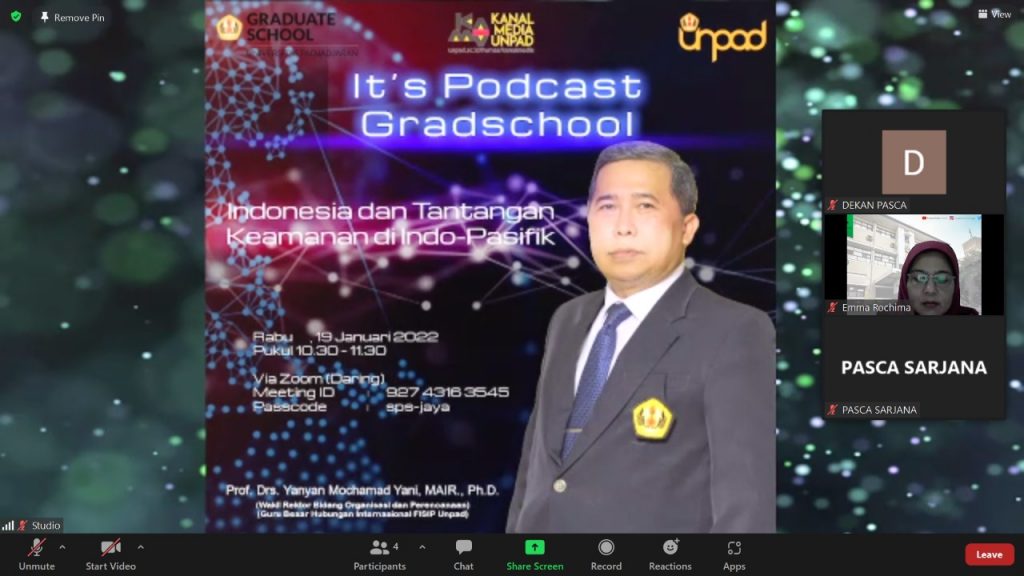
[GradSchool Unpad] Prof. Drs. Yanyan Mochamad Yani, MAIR., Ph.D. as Vice Rector IV, is in charge of aspects of governance and regulation of supporting policies at the university. But this time, he spoke as a whole person, telling stories about his memorable childhood, life experiences as an academic and his views on international relations scholarship regarding Indonesia and the Indo-Pacific Security Challenge.
The Indo-Pacific is the region that includes the Indian Ocean and the Pacific Ocean. The country’s economic potential in this region is enormous. In the context of national vigilance, we need to pay attention to cultural infiltration phenomena, such as K-Pop or J-Pop. These two things will more or less influence the lifestyle and behavior of consumers in Indonesia. Currently, vigilance needs to be increased. For example, the pattern of cooperation between China and Sri Lanka. There is a clause which states that China can control up to 100 years over assets built with loans from China which cannot be paid by Sri Lanka. This condition must be considered so that it does not occur in Indonesia.
Currently, in the Indo-Pacific region, there is a struggle for influence and power between China and America. Indonesia is the center of attention in the Indo-Pacific region with its natural wealth. The attention of the two superpowers to Indonesia is greater than to ASEAN. The government has been very clever in anticipating it, by encouraging western and eastern mobility by sea. What needs attention is anticipation and protection related to labor mobility. In Thailand, there are fine Thai language proficiency requirements for foreign workers. But in Indonesia, that requirement has not been fully enforced. For this reason, the Indonesian spirit of unity and oneness must be prioritized. Other countries in the Indo-Pacific region are very concerned about various policies in Indonesia. Some countries are worried, for example, if a nuclear power plant is built in Kalimantan. Likewise, if the state defense program is successfully implemented.
Prof Yanyan turned out to be with his expertise involved in assignments such as the secret service and was involved in working groups that produced strategic weapons assistance from Australia. That is perhaps the comparative advantage of being an Australian alumnus and international relations expert in strategic policy aspects.
Prof. Yanyan sees opportunities for cooperation in the regional context, suggesting the development of specializations based on regions such as Asia Africa, America, Australia, or the Indo-Pacific. There are many opportunities to take a multi-, and trans-disciplinary approach and involve academics as well as practitioners. One of the specializations that are thought to be interesting is Intelligent Strategic which is supported by various scholarships. The target audience for this interest can be politicians, military, business and others. Currently, there is only an ASEAN Study Center in FISIP. The need in the future is enormous, in line with the knowledge-based economy and knowledge management approaches.